
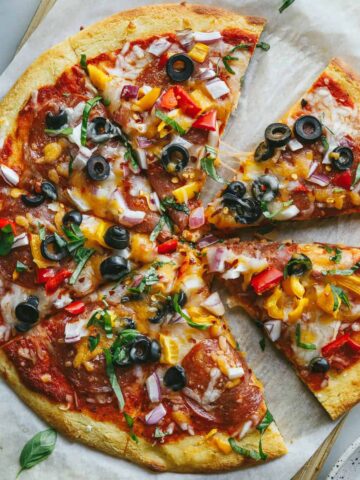
This grain-free pizza crust recipe proves that pizza night is still possible, even if you're sticking to low-carb and grain-free eating! The pizza crust is sturdy enough for all your favorite pizza toppings, yet soft and tender with a chewy texture.

Load it up all of your favorite pizza ingredients, a low-carb marinara, and you've got a grain-free and low-carb pizza that works for all eaters.
developing a grain-free pizza crust
Pizza is something I make on a regular basis, especially for the kiddos, and this grain-free pizza crust recipe has become my go-to!
When I first published this recipe several years ago, it was a basic almond flour pizza crust with margherita pizza toppings.
While it got the job done (a sturdy, flatbread style vessel for pizza toppings!), it was a little lacking, both flavor and texture-wise.
I have worked hard to perfect this low-carb pizza crust, adding lift, softness, and flavor that is more true to the traditional wheat-based pizza crust we know and love!
It's actually dough-y and soft, which can be incredibly difficult to achieve when working with grain-free ingredients.

why it works
- It's a grain-free pizza crust recipe that works for a variety of eaters. The dairy-free and gluten-free crust fits right into a paleo and low-carb diet, too.
- While the recipe makes about a 12-inch sized pizza (perfect for two people) you can easily double it to make two pizza crusts for a family.
- Load up the crust with your favorite toppings-- the options for customizing are endless.
- The combination of natural ingredients create a soft, pillowy dough with delicious pizza crust flavor.
the ingredients
This is a paleo pizza crust recipe that actually results in a soft pizza dough, rather than a flat, cardboard-like dough with no flavor.
When working with grain-free ingredients, our goal is to achieve a similar texture and flavor as the wheat-based counterparts, so it's all about knowing what alternatives to use and how to use them.
Here are the main ingredients you'll need. If you don't have all of these, check out the Substitutions section for ideas, but keep in mind that this list of ingredients will help you get the very best results.

- Yeast: We're relying on yeast for flavor! Yeast produces flavorful byproducts like organic acids and esters during fermentation. This in part is what gives pizza crust that signature "bready," slightly-tangy aroma and taste. Grain-free flours (like almond and coconut) don't have gluten to trap the gas bubbles yeast makes, so you won't get the same lift as you can expect with traditional flour - but you will get flavor. You'll activate the yeast with warm water and a splash of maple syrup.
- Almond flour, coconut flour, and arrowroot starch: The combination is the base of your grain-free pizza crust. Use fine, blanched almond flour (not almond meal) and make sure to spoon and level each ingredient for precise measuring.
- Psyllium husk fiber: This is a soluble fiber that produces a gel-like substance when mixed with water, and it's key to getting a dough with stretch and softness. Adding psyllium husk to our dough helps create a dough with more elasticity and structure which mimics a dough with gluten. It'll help your pizza dough hold together and prevent it from crumbling. Psyllium husk also traps air from leavening agents (like baking powder or yeast), creating a more open crumb.
- Seasonings: A pinch of sea salt, a splash of apple cider vinegar, and a little bit of Italian seasoning add extra flavor to the paleo pizza dough.
- Eggs: These work as a binder and help add moisture, which can make the difference between a dry, flat, and crumbly crust and a soft, bread-like crust.
- Olive oil or avocado oil: Adds fat and moisture to the dough which helps create a more tender crust.
You'll also need a rolling pin and parchment paper (or a baking mat).
how to make a grain-free pizza crust
This is the best paleo pizza crust, and once you have all the ingredients ready, it's actually quite easy to make!
Here's a look at the process but be sure to scroll to the printable recipe card at the bottom of the page for all of the details:
- Activate the yeast: Mix together the yeast with the warm water and maple syrup in a small bowl. Set aside for 5 minutes. Once it has become frothy, mix in 1 teaspoon of psyllium husk powder. Set aside again for 5 minutes. The mixture will become gel-like.
- Make the almond flour pizza crust: In a large mixing bowl, combine the dry ingredients (almond flour, arrowroot flour, coconut flour, baking soda, salt, and seasonings). In a separate bowl, add the eggs, apple cider vinegar, and oil. Pour the yeast and psyllium husk mixture into the wet ingredients and whisk well. Pour the wet mixture into the bowl with the flours, then stir well until the mixture resembles a soft dough. If it appears really sticky, you can mix in another ½ to 1 tablespoon of coconut flour. Form a dough ball in the bowl, then cover the bowl and place the dough in the refrigerator for 30 minutes.
- Roll out the crust: Spread out a piece of parchment paper (or a baking mat) and turn out the dough. Flatten out the dough ball with your hands and then use a rolling pin to roll it out until it's about ¼-inch thick.
- Bake: Transfer the parchment paper and dough to a large baking sheet. Place it in your preheated oven and bake at 425°F for 5-7 minutes. Remove, then add your favorite toppings (tomato sauce, mozzarella cheese, pepperoni, etc.!). Return to the oven and bake for another 5-6 minutes or until the cheese has melted. Top with red pepper flakes and fresh basil, if desired.


recipe notes
- Baking the crust on its own for a few minutes helps to cook it evenly without the weight of pizza toppings. You don't want it fully-cooked before adding the toppings, just a tad golden brown is ideal. The cooking time may vary slightly based on your oven and the thickness of your crust.
- Use warm water (about 95-105°F) to activate the yeast.
- Psyllium husk fiber is quite essential to creating a soft, stretchy dough and chewy crust. If this ingredient is skipped, you'll still have a dough with decent flavor, but it will turn out more flat, crisp, and dry. Since psyllium husk also absorbs a lot of moisture (and holds it), you may find that skipping this ingredient creates a stickier dough which you can fix with another tablespoon of coconut flour.
- Make sure to roll out the dough onto a sheet of parchment paper or a baking mat so you can easily lift it and place it right on a baking sheet, pizza pan, or pizza stone.
- Arrowroot powder is a lot higher glycemic than almond flour and coconut flour, but since our dough is not all arrowroot and it has a balance of fiber, fat, and protein, I believe this grain-free pizza crust to also be low carb and blood sugar friendly.
- Double the recipe for a larger pizza or two 12-inch pizzas if you're feeding more than two people.
adding yeast for flavor
We're relying on some of the same characteristics that yeast will add to traditional, wheat-flour based pizza dough.
While yeast won't give our low-carb and grain-free pizza crust a lot of rise, it still works wonders for flavor!
While you certainly can bake the dough after it sits for 15 minutes, a longer ferment will create a deeper flavor and give your crust more of that pronounced "real pizza" aroma and taste.
If I have the time, I prefer letting the dough sit for 30-60 minutes. You can even refrigerate the dough overnight for a deeper, sourdough-like note.

substitutions
I don't have a substitution suggestion for every ingredient, since this recipe really relies on each ingredient working together. However, here are some substitutions I feel comfortable making to achieve similar results.
- Maple syrup: You can substitute for a small amount of honey or even plain sugar. I don't recommend a low-carb sweetener because we actually want the added sugar to help activate the yeast. (If you are low carb, don't worry- the yeast eats up all the sugar and this won't add any extra grams of carbs or sugar to your crust!)
- Arrowroot powder: You can substitute it with the same amount of tapioca flour (or tapioca starch), if preferred.
- Apple cider vinegar: The same amount of fresh lemon juice will add a similar tanginess to the crust.
- Italian seasoning: You can make your own with a combination of dried herbs like oregano, parsley, and thyme. Or, skip this ingredient entirely. A pinch of garlic powder also adds a nice flavor element.
- Extra virgin olive oil: Substitute for avocado oil, coconut oil, or even melted ghee.
storage
You can store this low carb pizza crust as dough in the refrigerator Keep it in an airtight container for up to four days.
If you have any leftover pizza, store it in the fridge, covered, for up to three days and reheat in the microwave or toaster oven.
you might also love
- Pizza Salad Recipe (with Italian Vinaigrette)
- Sunflower Cashew Ricotta
- Grilled Whole Branzino with Herb Walnut Sauce
- Keto Cottage Cheese Pizza Crust

Grain-Free Pizza Crust (Low Carb, Gluten Free)
This grain-free pizza crust recipe makes a tender, soft, and chewy crust with low-carb ingredients.
One 12-inch pizza crust will serve 2-4 (the crust is nutrient-dense and filling), so double or triple the recipe if needed.
Ingredients
- 1-½ teaspoons active dry yeast
- 3 tablespoons warm water (about 100-110°F)
- 1 teaspoon maple syrup
- 1 cup blanched almond flour
- 3-4 tablespoons coconut flour
- ½ cup arrowroot starch
- 1 teaspoon baking soda
- ¼ teaspoon fine sea salt
- 1 tablespoon Italian seasoning (optional)
- 1 teaspoon psyllium husk powder
- 2 large eggs
- 2 tablespoons extra-virgin olive oil or avocado oil
- 1 teaspoon apple cider vinegar
Instructions
- Activate the yeast: Add the yeast, water, and maple syrup to a small bowl. Whisk together, and set aside for 5 minutes to let the yeast activate. (The yeast will eat up all the sugar so the maple syrup will not increase the amount of sugar in the recipe).
- Combine dry ingredients: In a large mixing bowl, combine the almond flour, 3 tablespoons of coconut flour, arrowroot flour, baking soda, salt, and Italian seasoning, if using.
- Make the psyllium husk gel: Return to your yeast mixture and whisk in 1 teaspoon of psyllium husk powder. Let it sit again for 5 minutes. The mixture will slowly become gel-like in consistency. This adds elasticity, stretch, and moisture to the grain-free pizza dough.
- Combine dough ingredients: In a separate, smaller bowl, add the eggs, oil, and apple cider vinegar. Pour the yeast and psyllium husk mixture into the wet ingredients and whisk well. Pour the wet mixture into the bowl with the flours, then use a rubber spatula to stir until the mixture resembles a soft dough. If it appears really sticky, you can mix in another ½ to 1 tablespoon of coconut flour. Let it rest for another 5 minutes so the psyllium husk and coconut flour can absorb all of the moisture. The dough should be just somewhat tacky to the touch. It will appear too sticky to roll out but it will come together better after it chills.
- Refrigerate: Form the dough into a ball as best as you can within the mixing bowl. Cover with plastic wrap and place in the refrigerator for 30 minutes (longer is fine too, this can even chill overnight). For a quicker chill time, set the bowl in the freezer for 15 minutes.
- Roll out the dough: After it has chilled, the dough will be less sticky. Preheat your oven to 425°F. Set the dough on a piece of parchment paper and sprinkle the top with a small amount of arrowroot powder (or almond flour). Use a rolling pin to gently roll it out until it has formed a 12-inch circle, about ¼-inch thick.
- Bake: Transfer the parchment paper and dough to a large baking sheet. Place it in your preheated oven and bake at 425°F for 5-7 minutes. Remove, then add your favorite pizza toppings (sauce, cheese, etc.) Return to the oven and bake for another 5-6 minutes to allow your cheese to melt and the crust to firm up along the edges.
Notes
- When measuring dry ingredients like almond flour, coconut flour, and arrowroot powder, spoon them into measuring cups/spoons and use a butter knife to level the top. This helps prevent over-packing the measuring cup/spoon. Ingredients like coconut flour, arrowroot, and psyllium husk are really absorbent so even a little less or a little more can affect your final result.
- The chill time for the dough is multi-purpose: First, it allows the yeast to ferment longer and create a deeper flavor to our gluten-free crust. Second, it gives the dough longer rest time so ingredients like psyllium husk and coconut flour can better absorb the moisture in the dough, which makes it easier to handle and roll out into a crust.
- If your dough still appears too sticky to roll out after the chill time, you can add another ½ tablespoon of coconut flour.
- Make sure to roll out the dough on the parchment paper or baking mat so you can easily lift it and place it right on a baking sheet, pizza pan, or pizza stone.
- This recipe makes a small, 12-inch pizza. Double the recipe for a larger pizza or to make two small pizzas if you're feeding more than 2-3 people. Since this is made with nutrient-dense ingredients one slice of grain-free pizza will be more filling than a typical, wheat-based pizza crust.
- Psyllium husk fiber is quite essential to creating a soft, stretchy dough and chewy crust. If this ingredient is skipped, you'll still have a dough with decent flavor, but it will turn out more flat, crisp, and dry. Since psyllium husk also absorbs a lot of moisture (and holds it), you may find that skipping this ingredient creates a stickier dough which you can fix with another tablespoon of coconut flour.
Nutrition Information
Yield 4 Serving Size 1Amount Per Serving Calories 361Total Fat 25gSaturated Fat 3gTrans Fat 0gCholesterol 93mgSodium 515mgCarbohydrates 19gNet Carbohydrates 12gFiber 7gSugar 3gProtein 12g
This nutritional information is approximate and is provided for convenience as a courtesy.

Did you make this recipe? Let me know!